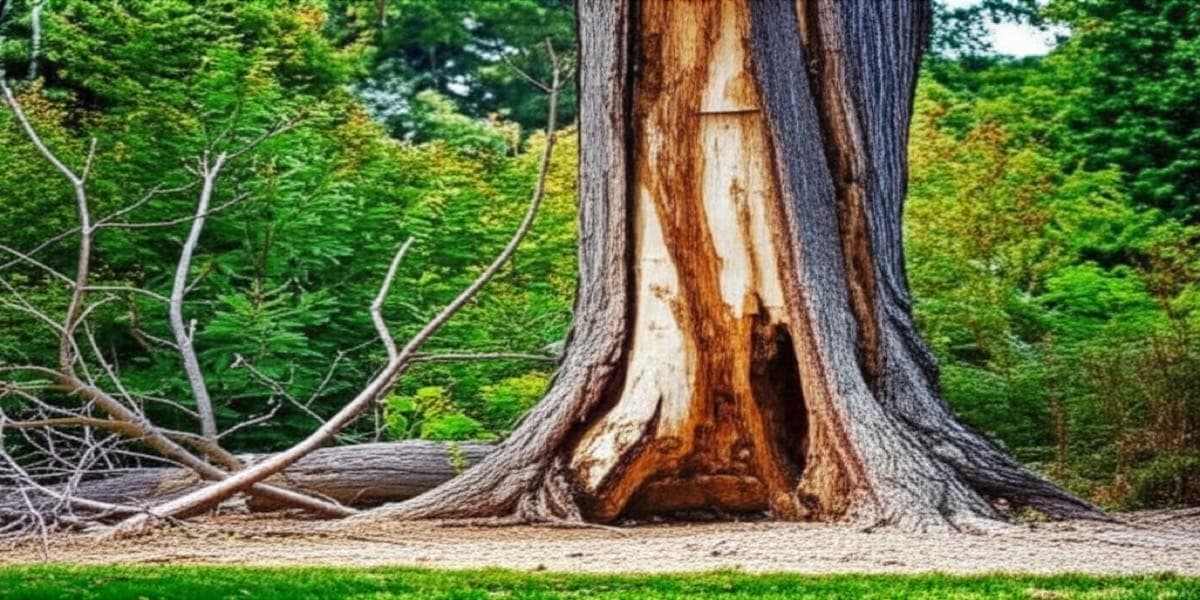
Trees add beauty, shade, and value to Fort Wayne properties, but they can also become hazards. Knowing when a tree has crossed from asset to liability protects your family, home, and neighbors. Some warning signs are obvious; others require careful observation. This guide helps you identify trees that may need removal.

What Are the Main Signs a Tree Should Be Removed?
The primary indicators that a tree needs removal include significant trunk decay or damage, dead or dying crown, severe lean (especially sudden), major root damage, and structural defects like co-dominant stems with included bark. Any single sign warrants professional evaluation; multiple signs often indicate removal is necessary.
Warning Sign Categories
| Category | Examples |
|---|---|
| Trunk issues | Decay, cavities, cracks, wounds |
| Crown problems | Dead branches, sparse foliage, dieback |
| Root concerns | Visible damage, heaving, mushrooms |
| Structural defects | Lean, co-dominant stems, weak unions |
| Health decline | Leaf problems, bark changes, pests |
How Can You Tell If a Tree Is Dead or Dying?
A dead tree shows no green under the bark, has brittle branches that snap easily, and lacks any leaf growth during the growing season. A dying tree may show partial crown death, sparse or discolored foliage, and progressive decline over seasons. Dead trees should be removed promptly—they become increasingly hazardous as they decay.
Dead Tree Indicators
- Scratch test: No green layer under bark
- Branch test: Branches snap, don’t bend
- Bark: Falling off, loose
- Foliage: None during growing season
- Fungi: Mushrooms on trunk (wood decay)
Dying Tree Signs
- Gradual crown thinning
- Dieback from tips
- Abnormal leaf drop
- Stunted leaf growth
- Bark abnormalities
- Increased pest activity
What Trunk Problems Indicate Removal?
Significant trunk decay, large cavities, deep cracks, and major wounds compromise structural integrity. Trees can survive with some trunk damage, but when decay affects more than 1/3 of the trunk circumference, the risk of failure increases substantially.
Trunk Issues to Watch
Decay and cavities:
- Soft, punky wood
- Hollow areas
- Shelf fungi (conks)
- Missing bark with exposed wood
Cracks:
- Deep vertical splits
- Horizontal cracks
- Cracks through branch unions
- Multiple intersecting cracks
Wounds:
- Large old wounds
- Multiple trunk wounds
- Wounds that won’t close
- Carpenter ant activity

When Does Lean Become Dangerous?
Trees naturally lean toward light, and gradual lean with buttress roots on the tension side can be stable for decades. Sudden lean, lean with heaving soil, or lean without compensating root structure indicates potential failure. New lean after storms is particularly concerning.
Lean Assessment
| Lean Type | Risk Level |
|---|---|
| Natural, gradual lean | Monitor |
| Lean with strong buttress | Often stable |
| Sudden lean | High risk |
| Lean with soil heaving | Immediate risk |
| Lean toward target | Higher concern |
Red flags:
- Recent change in lean
- Cracked soil at base
- Exposed roots on one side
- Lean increased after storm
What Root Problems Signal Danger?
Root damage from construction, grade changes, or disease compromises stability. Since most structural roots are in the top 12-18 inches of soil, surface disturbance can have severe impacts. Root decay is often hidden until failure occurs.
Root Warning Signs
- Mushrooms at base: Root decay likely
- Heaving soil: Root failure starting
- Severed roots: Construction damage
- Root decay: Soft, punky tissue
- Girdling roots: Circling, strangling trunk
High-Risk Root Damage
| Damage | Risk |
|---|---|
| 40%+ root zone disturbed | High |
| Major roots cut | High |
| Root decay visible | High |
| Soil grade changed | Moderate-High |
How Do Branch Problems Indicate Tree Health?
Dead branches throughout the crown, especially large ones, indicate overall decline. Trees naturally shed small interior branches, but dead branches in the upper crown or on major limbs suggest systemic problems or irreversible decline.
Branch Assessment
Normal shedding:
- Small interior branches
- Lower shaded branches
- Consistent with species
Concerning patterns:
- Large dead branches
- Dead branch tips
- Dieback progressing inward
- One-sided crown death

What Structural Defects Require Attention?
Co-dominant stems (two trunks of equal size), included bark (bark growing into branch unions), and previous topping create structural weaknesses. These defects don’t necessarily mean removal, but they increase failure risk and warrant professional evaluation.
Structural Problems
| Defect | Description | Risk |
|---|---|---|
| Co-dominant stems | Two equal-sized trunks | Moderate-High |
| Included bark | V-shaped union with bark inside | Moderate-High |
| Previous topping | Multiple sprouts from cuts | High |
| Lion’s tailing | Over-thinned interior | Moderate |
Co-dominant stem concerns:
- Bark inclusion in union
- Size imbalance developing
- History of similar failures
- Targets in failure zone
When Should Trees Near Structures Be Removed?
Trees within falling distance of homes, utilities, or other structures require higher standards for retention. The consequence of failure—damage to property or injury—makes questionable trees poor risks.
Target assessment:
- What could the tree hit?
- How often are people/property in the target zone?
- What’s the cost of failure?
Higher-risk situations:
- Large trees over homes
- Trees touching structures
- Trees over driveways/parking
- Near power lines
What About Storm-Damaged Trees?
Storm damage ranges from minor branch loss to catastrophic structural failure. Assess damage severity, remaining structure, and recovery potential. Trees that lost more than 50% of their crown or suffered major structural damage often don’t recover well.
Post-Storm Assessment
| Damage Level | Typical Recommendation |
|---|---|
| Minor branch loss | Prune, retain |
| Significant branch loss | Evaluate, often retain |
| Major limb failure | Professional assessment |
| Trunk damage | Often remove |
| Uprooting/lean | Usually remove |
What’s the Process for Removing a Tree?
Tree removal involves assessment, permitting if required, safe felling, and stump treatment. Professional removal is recommended for trees near structures, power lines, or requiring technical rigging.
Removal Considerations
- Permits: Some municipalities require permits
- Utilities: Call 811 before digging
- Access: Equipment access needs
- Debris: Disposal or processing
- Stump: Grind, remove, or leave
Our tree care services provide professional assessment and removal throughout Fort Wayne.
Request a Free Quote or call us at (260) 450-4676 for tree evaluation.
Frequently Asked Questions
Can a dead tree stay standing?
Dead trees become progressively more hazardous as they decay. Removal is recommended, especially if near targets.
Should I get a second opinion?
For expensive removals or if you want to save the tree, consulting a certified arborist for assessment is worthwhile.
What about trees that seem fine but I don’t want?
Healthy trees can be removed for landscape reasons, but consider the loss of shade, property value, and environmental benefits.
Adam Minnick is the owner of Minnick Lawn & Landscaping, serving Fort Wayne, Auburn, and Northeast Indiana since 2018.