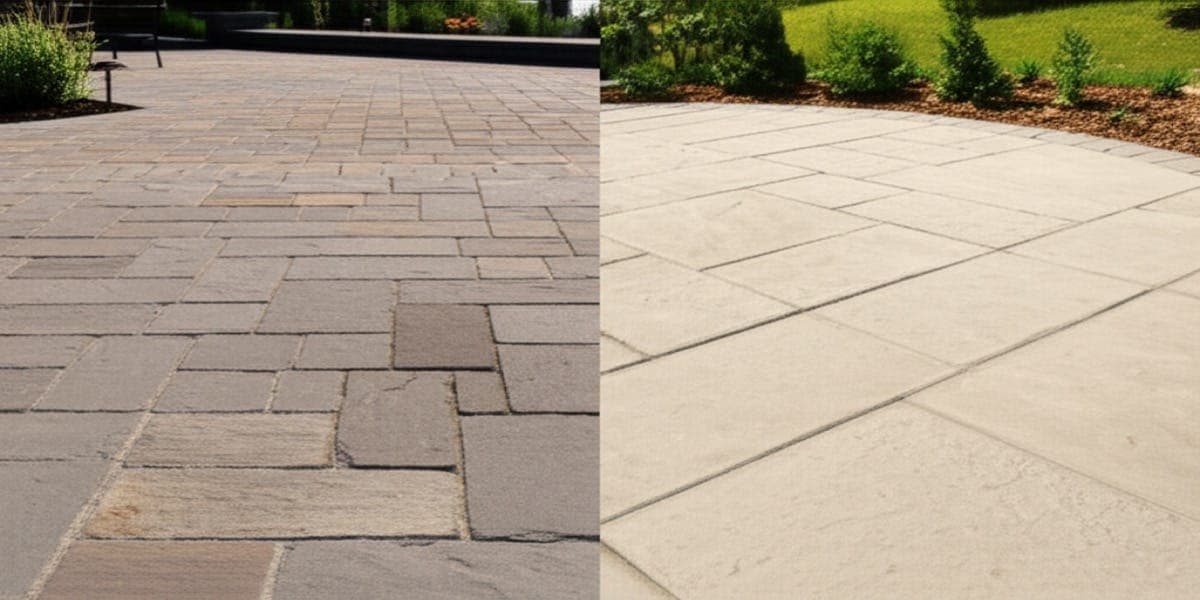
Beautiful paver patio in Fort Wayne backyard compared to concrete patio

The patio is the foundation of your outdoor living space, and choosing between pavers and concrete is one of the biggest decisions you’ll make for your backyard. Both options create durable, functional outdoor surfaces, but they differ significantly in appearance, cost, installation, maintenance, and long-term value. Understanding these differences helps you choose the right material for your Fort Wayne property.

This guide provides an honest comparison of paver patios and concrete, covering the factors that matter most for Northeast Indiana homeowners.

Side-by-side comparison of paver and concrete patios

What’s the Difference Between Pavers and Concrete?

Pavers are individual interlocking units (concrete, brick, or stone) set on a compacted base with sand joints, allowing for flexibility and easy repair of individual pieces. Poured concrete is a monolithic slab that provides a continuous surface but can crack over time and is more difficult to repair. Each approach has distinct advantages depending on your priorities.

Quick Comparison

FactorPaversConcrete
Initial costHigherLower
Installation timeLongerShorter
AppearancePattern varietySolid or stamped
Durability25-50+ years25-30 years
Repair easeIndividual unitsDifficult/patches
MaintenanceModerateLow-moderate
Resale valueHigherModerate
DIY feasibilityPossibleNot recommended

How Each Material Works

Pavers:

  • Individual units interlock
  • Set on compacted gravel and sand
  • Joints filled with polymeric sand
  • Flexible system absorbs movement
  • Can be lifted and reset

Concrete:

  • Mixed and poured as liquid
  • Cures to solid slab
  • Requires expansion joints
  • Rigid system can crack
  • Repairs are patched

How Does Cost Compare Between Pavers and Concrete?

A basic concrete patio costs $8-15 per square foot installed, while paver patios range from $15-30+ per square foot depending on material and pattern complexity. However, long-term costs often favor pavers due to easier repairs and longer functional lifespan before replacement is needed.

Cost Breakdown

ComponentConcretePavers
Materials (per sq ft)$2-4$4-15
Base preparation$1-2$2-4
Labor$4-8$8-15
Total installed$8-15$15-30+

Typical Project Costs (300 sq ft patio)

ProjectConcrete RangePaver Range
Basic$2,400-3,000$4,500-6,000
Mid-range$3,000-4,000$6,000-8,000
Premium$4,000-6,000$8,000-12,000+

Long-Term Cost Factors

Concrete long-term costs:

  • Crack repairs: $50-200 each
  • Resurfacing: $2-5/sq ft
  • Full replacement: Required eventually
  • Average lifespan: 25-30 years

Paver long-term costs:

  • Unit replacement: $5-15 per paver
  • Re-leveling: $100-300
  • Sealing: $0.50-1.50/sq ft every 2-3 years
  • Average lifespan: 25-50+ years

Which Material is More Durable?

Both properly installed pavers and concrete can last 25+ years, but they handle stress differently. Pavers are more resistant to cracking because the joints absorb movement from freeze-thaw cycles and settling, while concrete’s rigid nature makes it prone to cracking that worsens over time without proper repair.

Durability Comparison

FactorPaversConcrete
Compression strength8,000+ PSI3,000-4,000 PSI
Freeze-thawExcellentGood (can crack)
Ground settlingAdaptsCracks
Vehicle weightCan handleCan crack
StainingModerateAbsorbs stains

Northeast Indiana Climate Considerations

Freeze-thaw cycles:

  • Fort Wayne averages 100+ freeze-thaw cycles annually
  • Pavers flex at joints, reducing damage
  • Concrete can crack if joints inadequate

Ground movement:

  • Clay soils expand/contract seasonally
  • Pavers shift and resettle
  • Concrete slabs may crack or heave

Repair Implications

Paver repairs:

  • Remove affected units
  • Re-level base
  • Replace units (matching possible)
  • Nearly invisible repair

Concrete repairs:

  • Crack fillers (visible)
  • Patching (color mismatch)
  • Resurfacing (temporary fix)
  • Eventually needs replacement

Paver patio showing durability and flexibility

What Are the Maintenance Requirements?

Pavers require periodic joint sand replenishment and optional sealing every 2-3 years, while concrete needs crack monitoring, occasional sealing, and eventual resurfacing. Neither material is maintenance-free, but concrete often appears lower-maintenance until cracks develop and become a recurring issue.

Maintenance Comparison

TaskPaversConcreteFrequency
SweepingSameSameWeekly
WashingSameSameSeasonally
Weed controlIn jointsIn cracksAs needed
Joint sandRequiredN/A1-3 years
SealingOptionalOptional2-3 years
Crack repairRareCommonAs needed
Settling repairLift/resetDifficultAs needed

Common Paver Maintenance

  1. Joint sand replenishment

    • Polymeric sand washes out over time
    • Reapply every 1-3 years
    • Prevents weed growth
    • Maintains interlock
  2. Sealing (optional)

    • Enhances color
    • Protects from stains
    • Reduces weed growth
    • Reapply every 2-3 years

Common Concrete Maintenance

  1. Crack monitoring/repair

    • Fill small cracks promptly
    • Prevents water infiltration
    • Slows crack expansion
    • May require professional repair
  2. Sealing (recommended)

    • Protects from stains
    • Reduces water penetration
    • Extends lifespan
    • Reapply every 2-3 years

How Do Appearance and Design Options Compare?

Pavers offer vastly more design options—colors, shapes, patterns, and textures—that can’t be matched by plain concrete. Stamped or stained concrete can mimic some paver looks but typically appears less authentic. Pavers provide a higher-end, more customized appearance that enhances property aesthetics.

Design Options

OptionPaversConcrete
ColorsDozensLimited (staining adds)
PatternsUnlimitedStamping limitations
ShapesMany optionsFormed, limited
TexturesMultipleStamped/broom
BordersEasy accentDifficult
CurvesNaturalRequires forms
  • Running bond - Simple, classic
  • Herringbone - Traditional, strong
  • Basket weave - Interesting texture
  • Circular - Focal point option
  • Random - Natural look

Concrete Enhancement Options

  • Stamped - Mimics stone/brick ($2-6 extra)
  • Stained - Adds color ($2-4 extra)
  • Exposed aggregate - Textured surface ($2-4 extra)
  • Broom finish - Basic texture (standard)

Various paver patterns and design options

Which is Better for DIY Installation?

Paver patios are achievable DIY projects for motivated homeowners with proper preparation and patience. Concrete installation requires specialized equipment, precise timing, and professional expertise—a DIY concrete patio often results in subpar results and premature failure.

DIY Feasibility

FactorPaversConcrete
DIY possibleYesNot recommended
Skill levelModerateHigh
EquipmentBasic toolsSpecialized
Timing criticalNoYes (must pour/finish quickly)
MistakesFixablePermanent
Physical demandHighVery high

DIY Paver Project Considerations

Realistic for DIY:

  • Smaller patios (under 200 sq ft)
  • Simple patterns
  • Level ground
  • Time to do it right

Better left to pros:

  • Large areas
  • Complex patterns
  • Significant grading
  • Time constraints

Why Concrete is Difficult DIY

  • Requires ordering and timing delivery
  • Must pour, screed, float, finish in sequence
  • Limited working time before setting
  • Mistakes are permanent
  • Requires proper expansion joints
  • Heavy, physically demanding

How Does Each Material Handle Drainage?

Permeable pavers allow water to drain through joints into the ground, reducing runoff and potentially eliminating the need for additional drainage infrastructure. Solid concrete requires proper slope (1-2%) to direct water away and may need additional drainage solutions.

Drainage Comparison

FactorPaversConcrete
Water penetrationThrough jointsNone
RunoffReducedSignificant
Permeable optionsAvailableNot possible
Slope requirementYesYes
Standing waterRareCan occur

Permeable Paver Benefits

  • Meet stormwater regulations
  • Reduce drainage infrastructure
  • Better for environment
  • May qualify for incentives
  • Natural groundwater recharge

Drainage Design

Both materials require:

  • Minimum 1-2% slope away from structures
  • Proper base preparation
  • Consideration of drainage destination
  • Possible drain integration

What About Resale Value?

Quality paver patios typically add more value to homes than concrete patios—they’re perceived as higher-end improvements by most buyers. A well-designed paver patio can return 50-80% of its cost at resale, while concrete patios return less and may even need upgrading to appeal to buyers.

Value Comparison

FactorPaversConcrete
Perceived valueHigh-endStandard
ROI at sale50-80%30-50%
Buyer appealStrongModerate
Upgrade neededRarelyOften

What Buyers Prefer

  • Outdoor living spaces highly desired
  • Quality materials appeal to buyers
  • Pavers suggest attention to detail
  • Well-maintained patios sell homes

Our hardscaping services include both paver and concrete patio installation.


Make the Right Choice for Your Home

Both pavers and concrete create functional, attractive patios. Pavers offer superior aesthetics, durability, and repairability at higher initial cost. Concrete costs less upfront but may require more maintenance and earlier replacement. Consider your priorities, budget, and long-term plans when deciding.

Request a Free Quote or call us at (260) 450-4676 to discuss patio options for your property.


Frequently Asked Questions

Can I put pavers over existing concrete?

Yes, if the concrete is level and in decent condition. However, this raises the height and may require transitions. Proper base preparation for a new paver patio often produces better results.

How long does a paver patio take to install?

A typical 300-400 sq ft paver patio takes 3-5 days for professional installation. DIY projects take significantly longer, often 2-3 weekends or more.

Will weeds grow between pavers?

Weeds can grow in joints if polymeric sand isn’t properly installed or maintained. Proper installation and periodic re-sanding minimize weed growth. Sealing helps further.

Does concrete or pavers get hotter in summer?

Both absorb heat, with darker colors getting hotter. Lighter-colored pavers typically stay cooler than dark concrete. Both are cooler than asphalt.

How soon can I use a new patio?

Concrete requires 24-48 hours before walking and 7+ days before heavy use. Pavers can be walked on immediately after polymeric sand sets (24 hours after wetting).


Sources


Adam Minnick is the owner of Minnick Lawn & Landscaping, serving Fort Wayne, Auburn, and Northeast Indiana since 2018.