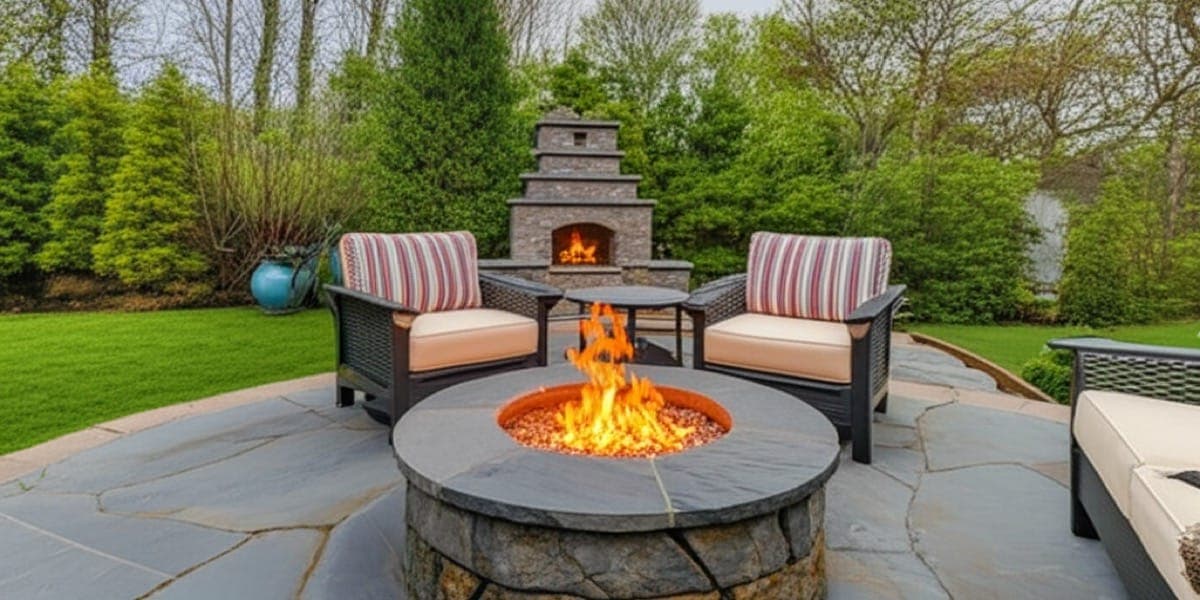
Beautiful backyard fire pit area with seating in Fort Wayne home

A fire pit transforms your backyard into a year-round gathering space, extending outdoor enjoyment well into cooler months and creating a natural focal point for entertaining. But successful fire pit areas require thoughtful planning—location, size, materials, seating, and safety considerations all affect how well the space functions and how often you’ll actually use it.

This guide walks you through planning a fire pit area that works for your Fort Wayne property, covering everything from site selection to seating arrangement and local regulations.

Completed fire pit area with seating at dusk

Where Should You Locate Your Fire Pit?

Locate your fire pit at least 10-20 feet from structures, property lines, trees, and combustible materials, with good drainage, protection from prevailing winds, and convenient access from your home. The ideal spot balances safety requirements with usability—too far from the house and you won’t use it; too close and it’s a safety concern.

Location Requirements

Distance FromMinimum
House/structures10-20 feet
Property lines10+ feet
Trees/shrubs10+ feet overhead/around
Fences (wood)10+ feet
Utility linesCheck local codes
Combustible materials10+ feet

Site Selection Factors

Safety considerations:

  • Away from structures
  • Clear overhead space (no branches)
  • Good drainage (no standing water)
  • Visible from house
  • Away from utility lines

Usability considerations:

  • Convenient access from home
  • Protected from wind
  • Level ground (or minor grading)
  • Good views
  • Social integration with landscape

Wind Considerations

  • Note prevailing wind direction
  • Position seating upwind when possible
  • Consider windbreak (wall, plantings)
  • Smoke drift affects enjoyment
  • May need multiple seating arrangements

What Size Should Your Fire Pit Be?

Fire pit diameter typically ranges from 36-48 inches for residential use, with the surrounding patio or gravel area extending 8-10 feet on all sides for comfortable seating and safe clearance. A typical complete fire pit area measures 18-24 feet in diameter, accommodating 6-10 people comfortably.

Fire Pit Sizing

Fire Pit SizeSeating CapacityPatio Diameter
36" diameter4-6 people16-18 feet
42" diameter6-8 people18-20 feet
48" diameter8-10 people20-24 feet

Space Planning

Fire pit ring:

  • 36-48" inside diameter
  • Wall thickness 6-12"
  • Height 12-18" typical

Seating zone:

  • 3-4 feet from fire pit edge
  • Allows comfortable heat
  • Safe from sparks

Outer zone:

  • Additional 2-4 feet
  • Movement space
  • Furniture placement

Total Area Calculation

For a 42" fire pit with proper seating:

  • Fire pit: 3.5 feet diameter
  • Seating zone: +7 feet (3.5 each side)
  • Movement zone: +4 feet
  • Total: ~18 feet diameter

Fire pit area dimensions and seating layout

What Materials Work Best for Fire Pits?

Fire pit construction typically uses fire-rated concrete blocks, natural stone, or manufactured fire pit kits, all designed to withstand repeated heating and cooling cycles. Surrounding surfaces can be pavers, gravel, flagstone, or concrete—avoid combustible materials like wood decking near the fire itself.

Fire Pit Materials

MaterialProsConsCost
Fire pit kitEasy, designed for heatLimited styles$$
Natural stoneBeautiful, uniqueHeavy, requires skill$$$
Concrete blockAffordable, easyBasic appearance$
Steel ringSimple, modernCan rust, hot to touch$-$$
Prefab steel bowlPortable, modernNot built-in look$$-$$$

Surround Materials

MaterialHeat ResistanceMaintenanceCost
GravelExcellentLow$
PaversGoodLow$$
FlagstoneGoodLow$$$
Poured concreteGoodModerate$$
Decomposed graniteExcellentLow$

What NOT to Use

Avoid near fire:

  • Wood decking (combustible)
  • Grass (burns, dies)
  • Mulch (combustible)
  • Pressure-treated lumber
  • River rock (can explode when heated)

What Are Your Fuel Options?

Fire pits can burn wood, natural gas, or propane, each with different ambiance, convenience, and cost implications. Wood-burning provides the most traditional experience with crackling sounds and natural aroma, while gas options offer push-button convenience and cleaner operation but higher installation costs.

Fuel Comparison

FactorWoodNatural GasPropane
AmbianceTraditional, bestGoodGood
ConvenienceLowestHighestHigh
Operating cost$-$$ per use$ per use$$ per use
InstallationSimpleComplexModerate
SmokeYesNoNo
MaintenanceAsh removalMinimalTank exchange
ControlNoneAdjustableAdjustable

Gas Fire Pit Considerations

Natural gas:

  • Requires gas line installation
  • Higher upfront cost
  • Lower operating cost
  • Unlimited fuel

Propane:

  • No permanent installation
  • Tank exchange/refill
  • Portable option
  • Higher operating cost

Wood-Burning Considerations

  • Requires wood storage
  • Creates smoke (neighbor consideration)
  • More atmospheric
  • Ash cleanup needed
  • May have burning restrictions

How Should You Arrange Seating?

Arrange seating 3-4 feet from the fire pit edge in a circular or semi-circular pattern, with chairs angled slightly toward the fire and each other to encourage conversation. Built-in seating walls provide permanent solutions, while portable furniture offers flexibility for different group sizes.

Seating Options

TypeProsCons
Built-in wallPermanent, defines spaceNo flexibility
Adirondack chairsClassic look, comfortableTakes space
Curved benchesFollows pit shapeLimited flexibility
Individual chairsFlexible arrangementMay need storage
CombinationBest of bothHigher cost

Seating Layout Tips

Circular arrangement:

  • Equal access to fire
  • Good conversation flow
  • Natural gathering pattern

Semi-circular:

  • Opens to view/house
  • Works with unequal space
  • Creates “stage” opposite

Spacing:

  • 3-4 feet from pit edge (comfortable heat)
  • 4-5 feet between seats (movement)
  • Consider prevailing wind in positioning

Fire pit seating arrangement options

What Are Fort Wayne Fire Pit Regulations?

Fort Wayne requires open burning permits and has specific regulations about fire pit size, location, and use. Check current city regulations before building, as rules change and violations can result in fines. Some neighborhoods have additional HOA restrictions.

General Guidelines (Verify Current Rules)

Typical requirements:

  • Distance from structures (10-25 feet)
  • Maximum fire size
  • Burning hours (often dusk restrictions)
  • Prohibited burn materials
  • Adult supervision required
  • Extinguishing method available

Common prohibited items:

  • Leaves/yard waste
  • Trash/household waste
  • Treated lumber
  • Plastics
  • During air quality alerts

What to Check

  1. City of Fort Wayne - Fire department/permits
  2. Allen County - County regulations
  3. HOA - Neighborhood restrictions
  4. Insurance - Homeowner policy implications

Best Practices

  • Keep extinguisher or hose nearby
  • Never leave fire unattended
  • Fully extinguish before leaving
  • Be considerate of smoke drift
  • Avoid burning during dry conditions

How Much Does a Fire Pit Area Cost?

A simple DIY fire pit ring costs $200-500, while a complete professionally installed fire pit area with paver surround and built-in seating ranges from $3,000-15,000+ depending on size and materials. Gas fire pits add $1,000-3,000+ for burner and installation.

Cost Breakdown

ComponentDIY RangeProfessional Range
Fire pit ring (basic)$200-500$500-1,500
Fire pit (premium)$500-1,500$1,500-4,000
Paver surround$500-1,500$2,000-5,000
Built-in seating$500-2,000$2,000-6,000
Gas conversion$500-1,000$1,000-3,000
Total project$1,000-5,000$3,000-15,000+

Value Considerations

  • High-use outdoor feature
  • Extends outdoor season
  • Popular with buyers
  • Good ROI at resale
  • Years of enjoyment

Our hardscaping services include custom fire pit area design and installation.


Create Your Perfect Gathering Space

A well-planned fire pit area becomes the heart of your outdoor living space. Take time to plan the location, size, and features that work for how you’ll actually use it, and you’ll create a space that draws family and friends together for years to come.

Request a Free Quote or call us at (260) 450-4676 to discuss fire pit design for your property.


Frequently Asked Questions

Do I need a permit for a fire pit in Fort Wayne?

Check current city regulations—requirements vary and change. Generally, permanent fire pits may require permits, and open burning has specific rules. A quick call to the fire department clarifies current requirements.

How deep should a fire pit base be?

A proper base includes 4-6 inches of compacted gravel for drainage, then paver sand or additional gravel. The fire pit walls typically sit on this base, not directly on soil.

Can I put a fire pit on my deck?

Generally not recommended on wood decks due to fire risk and heat damage. Fire-rated pads and elevated fire bowls can work on some composite decks—check manufacturer guidelines.

How far should seating be from the fire?

Position seating 3-4 feet from the fire pit edge for comfortable warmth without excessive heat. Closer seating may be uncomfortable; farther may not feel the warmth.

What’s the best size fire pit for a small backyard?

A 36" diameter fire pit with minimal surround works for smaller spaces, accommodating 4-6 people while leaving adequate clearance from structures.


Sources


Adam Minnick is the owner of Minnick Lawn & Landscaping, serving Fort Wayne, Auburn, and Northeast Indiana since 2018.