Your paver patio, walkway, or driveway represents a significant investment, and proper maintenance protects that investment while keeping your hardscape looking beautiful for decades. Regular cleaning, timely sealing, and prompt repairs prevent small issues from becoming expensive problems. Here’s your complete guide to hardscape maintenance in Fort Wayne’s challenging climate.

How Often Should You Maintain Hardscapes?
Basic cleaning should happen annually, sealing every 2-4 years, and joint sand replenishment as needed. Fort Wayne’s freeze-thaw cycles, road salt exposure, and seasonal debris create specific maintenance demands that other climates don’t face.
Maintenance Schedule
| Task | Frequency |
|---|---|
| Debris removal | Ongoing/weekly |
| Basic cleaning | Annually |
| Deep cleaning | Every 2-3 years |
| Sealer application | Every 2-4 years |
| Joint sand check | Annually |
| Weed control | As needed |
| Repairs | As needed |
How Do You Clean Pavers Properly?
Start with sweeping and rinsing, then address stains and buildup with appropriate cleaners. Pressure washing works for deep cleaning but requires proper technique to avoid damage. Regular cleaning prevents stains from setting and organic matter from degrading joints.
Basic Cleaning Steps
- Remove loose debris: Sweep or blow leaves, dirt, debris
- Rinse surface: Garden hose spray
- Treat stains: Apply appropriate cleaner
- Scrub if needed: Stiff brush for stubborn areas
- Rinse thoroughly: Remove all cleaner residue
Common Stain Treatments
| Stain Type | Treatment |
|---|---|
| Oil/grease | Degreaser, cat litter for fresh |
| Rust | Oxalic acid or rust remover |
| Organic (leaves, berries) | Oxygen bleach |
| Efflorescence (white haze) | Efflorescence cleaner |
| Algae/mold | Oxygen bleach or algaecide |
Important: Always test cleaners in an inconspicuous area first.

When Should You Pressure Wash?
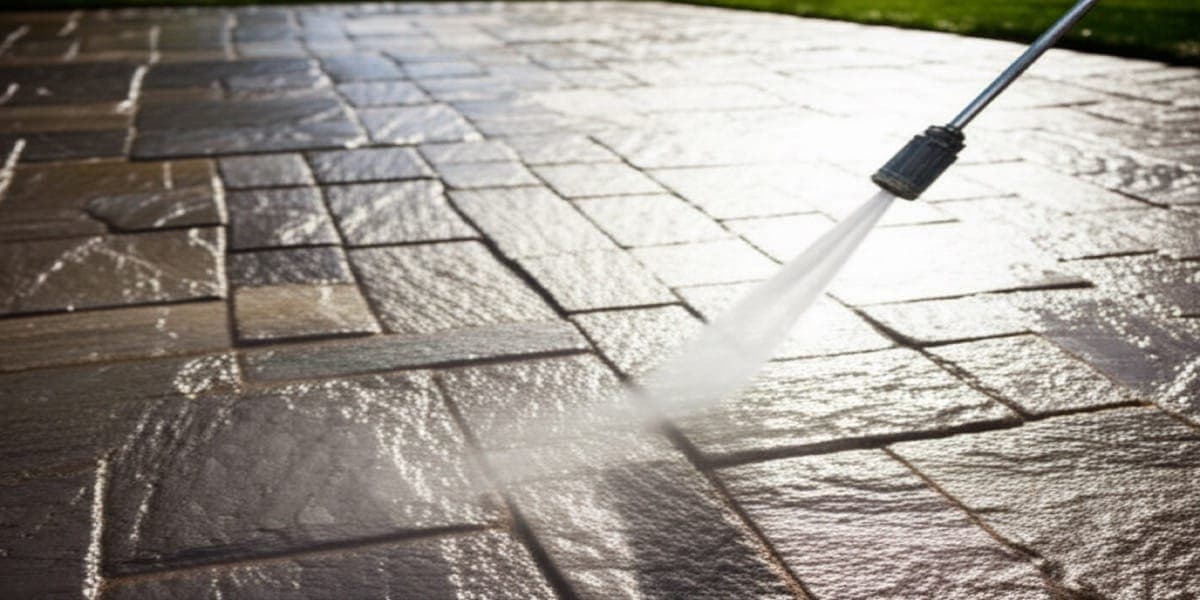
Pressure wash pavers every 2-3 years or when surface staining and grime require more than basic cleaning. Use proper technique—wrong pressure or angle can damage pavers, erode joint sand, and create more problems than it solves.
Pressure Washing Best Practices
Equipment:
- 1,500-2,000 PSI (not higher)
- 25-40 degree tip (never 0°)
- Surface cleaner attachment (optional)
Technique:
- Keep wand 8-12 inches from surface
- Maintain consistent distance
- Overlap passes
- Work in sections
- Follow with joint sand replacement
Avoid:
- Pressure above 2,500 PSI
- Narrow spray tips
- Holding in one spot
- Angling into joints
What Does Sealing Do for Pavers?
Sealing protects pavers from stains, enhances color, stabilizes joint sand, and can inhibit weed and ant intrusion. It’s not strictly necessary, but sealed pavers maintain their appearance better and are easier to clean.
Sealer Benefits
| Benefit | Explanation |
|---|---|
| Stain resistance | Prevents absorption |
| Color enhancement | Deepens or maintains color |
| Joint stabilization | Locks polymeric sand |
| UV protection | Reduces fading |
| Easier cleaning | Stains don’t penetrate |
| Weed inhibition | Blocks germination |
Sealer Types
Wet look (gloss):
- Darkens/enriches color
- Visible shine
- Shows traffic patterns faster
- Reapply every 2-3 years
Natural look (matte):
- Maintains original appearance
- No shine
- Hides wear better
- Reapply every 3-4 years
Penetrating:
- No appearance change
- Longest lasting
- Stain protection only
- Minimal maintenance
When to Seal
- New installation: Wait 60-90 days for efflorescence to pass
- After cleaning: Apply to clean, dry pavers
- Resealing: Every 2-4 years depending on traffic and product

How Do You Apply Sealer?
Proper sealer application requires clean, dry pavers, appropriate weather conditions, and correct product application. Most homeowners can apply sealer, but professional application ensures even coverage and proper product selection.
Application Steps
- Clean pavers thoroughly: No dirt, stains, or debris
- Replace joint sand if needed: Polymeric or regular
- Wait for dry conditions: 24-48 hours without rain
- Apply sealer: Roller, sprayer, or both
- Allow to cure: 24-48 hours before traffic
Application Tips
- Apply thin coats (2 thin > 1 thick)
- Work in sections
- Avoid puddles
- Maintain wet edge
- Apply when 50-80°F
- No rain for 24 hours
What About Joint Sand Maintenance?
Joint sand keeps pavers locked together and prevents weed growth. Regular sand washes out over time, while polymeric sand offers longer-lasting performance but costs more. Check joint levels annually and replenish as needed.
Joint Sand Types
| Type | Benefits | Lifespan |
|---|---|---|
| Regular | Inexpensive | 1-3 years |
| Polymeric | Weed/ant resistance, stability | 5-10 years |
| Polymeric + sealer | Maximum protection | 10+ years |
Joint Sand Replenishment
Signs you need sand:
- Visible gaps between pavers
- Paver movement
- Weed growth in joints
- Ant hills appearing
- Washout after rain
Application:
- Clean out old sand and debris
- Dry pavers completely
- Spread new sand
- Sweep into joints
- Compact or vibrate
- Water to activate (polymeric)
How Do You Handle Common Repairs?
Most hardscape repairs are straightforward: replacing broken pavers, addressing settling, and fixing drainage issues. The interlocking nature of pavers makes individual unit replacement much easier than fixing cracked concrete.
Common Issues and Fixes
| Problem | Cause | Solution |
|---|---|---|
| Cracked paver | Impact, settling | Replace individual paver |
| Sunken area | Base failure | Lift, recompact, reset |
| Paver wobble | Sand loss | Add joint sand |
| Edge spreading | No edging | Install edge restraint |
| Weed growth | Joint failure | Replace sand, seal |
| Efflorescence | Mineral deposits | Clean with proper product |
Replacing a Paver
- Remove sand around paver
- Pry out damaged paver
- Check and level base
- Insert new paver
- Fill joints with sand
- Compact if needed

What Special Care Does Winter Require?
Fort Wayne winters challenge hardscapes with freeze-thaw cycles, salt exposure, and snow removal. Proper winter practices protect your investment.
Winter Protection
Salt alternatives:
- Calcium chloride (less damaging)
- Magnesium chloride (plant-safe)
- Sand for traction (no chemical)
- Avoid rock salt when possible
Snow removal:
- Plastic shovel (won’t scratch)
- Snowblower (careful on edges)
- Plow with rubber blade only
- Clear before ice forms
Post-winter:
- Rinse off salt residue
- Check for heaved pavers
- Inspect joint sand
- Plan spring cleaning
What Does Professional Maintenance Cost?
Professional cleaning and sealing costs vary by area size and service level. For most homeowners, professional service every 2-4 years combined with DIY routine maintenance provides the best value.
Professional Service Costs
| Service | Cost Range |
|---|---|
| Cleaning (per sq ft) | $0.25-0.50 |
| Sealing (per sq ft) | $0.50-1.50 |
| Clean + Seal combo | $0.75-1.75 |
| Joint sand replacement | $0.50-1.00 |
| Repairs | Varies by scope |
Sample project (500 sq ft patio):
- Basic cleaning: $125-250
- Clean + seal: $375-875
Our hardscaping services include maintenance, cleaning, and sealing for Fort Wayne properties.
Request a Free Quote or call us at (260) 450-4676 for hardscape maintenance service.
Frequently Asked Questions
Can I seal pavers myself?
Yes, with proper preparation and application technique. However, professional application ensures correct product selection and even coverage.
How long does sealer last?
Most sealers last 2-4 years depending on traffic, exposure, and product type. High-traffic areas may need more frequent resealing.
Should I seal natural stone the same as pavers?
Natural stone requires different sealers than concrete pavers. Always use products designed for your specific stone type.
Adam Minnick is the owner of Minnick Lawn & Landscaping, serving Fort Wayne, Auburn, and Northeast Indiana since 2018.